
9 min read
Anyone can publish a website in an afternoon now. Templates, drag-and-drop editors, and hosted platforms handle the code, the hosting, and the security. If you are figuring out how to start a website design and content creation business, that raises an obvious question: if the tools are this easy, who would pay you?
Small business owners still pay, because the tools removed the technical work and left the rest. Someone still has to decide what the business says, make the site fast and recognizably theirs, and keep new content going out week after week. Those jobs take time and judgment, and most owners have neither to spare.
The tools got easier, but small businesses are still stuck
A template gives an owner an empty layout with placeholder text and stock photos. It does not tell them what to write in the headline, which services to put first, how many pages they need, or what to say on the About page. Each of those is a decision, and the builder cannot make it for them.
The usual result is a site that stalls at about 70 percent. The home page is done, the services page has two lines, the contact form was never tested, and the opening hours are from the previous season. The owner meant to return to it, but customers, suppliers, and invoices took priority.

This is the situation a freelancer can step into. You are not selling access to a tool the owner could open themselves. You are selling finished work and the decisions behind it, delivered by someone who has the time.
What a small business needs from a website
A small business site has three jobs. It has to load quickly, say clearly what the business does, and look like the business it represents.
It loads fast
Most slow small business sites are slow for ordinary reasons. Photos are uploaded straight from a phone at full size, a dozen plugins or add-ons each load their own scripts, and a background video plays on the home page. Fixing this is routine work:
- Resize and compress images before uploading them.
- Use one or two fonts instead of five.
- Remove add-ons the site does not need.
- Test the pages on a phone connection, and run them through a free tool such as Google PageSpeed Insights to find what is slowing them down.
Owners rarely check any of this, because the site looks fine on their office computer.
It reads clearly
A visitor should know within the first screen what the business does, where it operates, and how to reach it. For a local service business, that means a clear headline, a short line about who the service is for, and a tappable phone number on a mobile screen. Clever taglines and long mission statements push that information down the page.
Clear writing also means choosing what to leave out. An owner may want to list every service they have ever offered. Your job is to put the three that bring in most of the work at the top and group the rest.
It looks like them
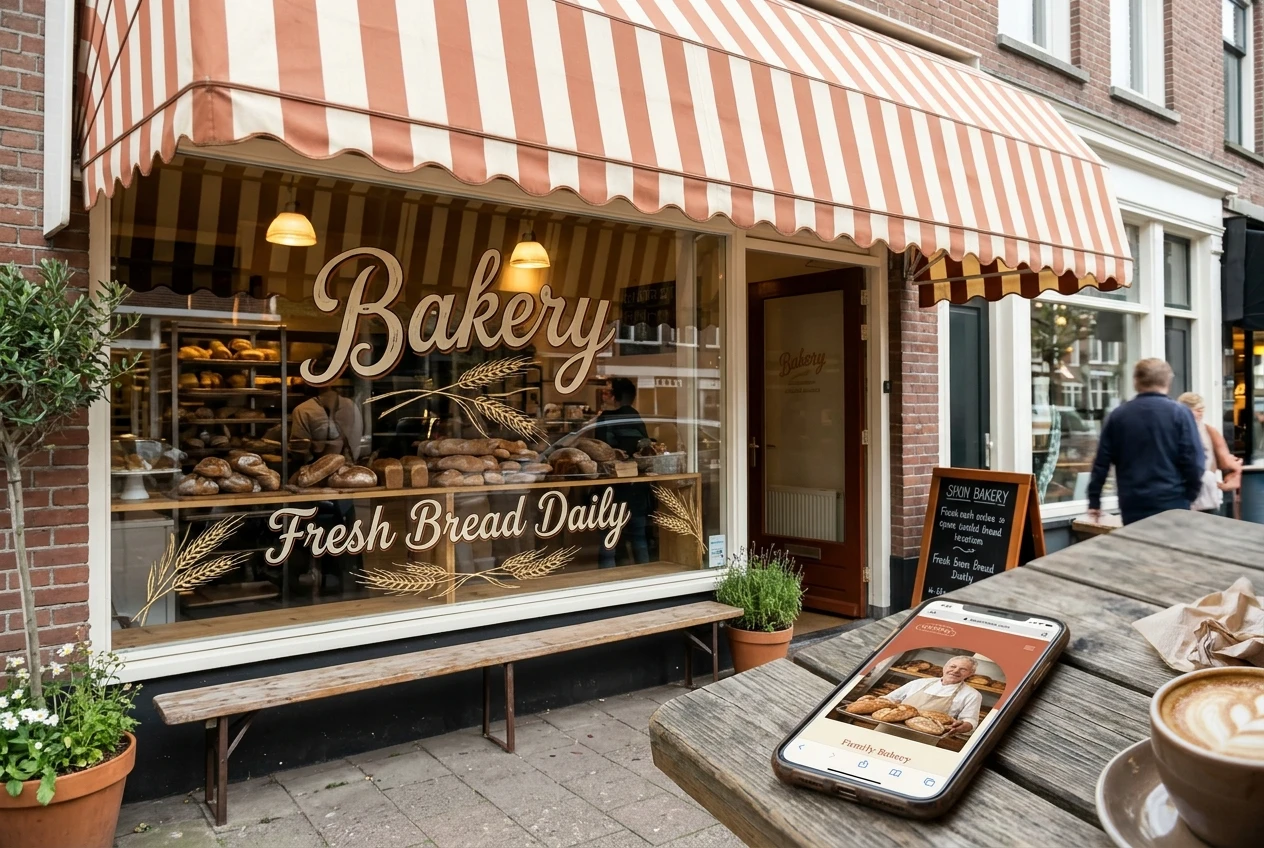
A site for a family bakery should not look like a site for an accounting firm, even if both start from the same template. A business’s look comes from specific choices: colors taken from the shopfront or logo, photos of the actual people and work instead of stock images, and wording that matches how the owner talks to customers. When a visitor walks in or calls later, the experience should match what they saw online.
Why posting week after week is the harder job
A site build is a project. It has a start, a list of pages, and a launch day. Content has no end date. A blog post, a social post, or a short email newsletter is finished in a day, and the next one is due the following week.
Each piece needs an idea, a draft, an image, owner approval, and a publish time. Multiply that by every week of the year and the cost becomes clear. The writing is not especially hard. The difficulty is that owners put the task off whenever a customer needs something, and customers always need something.

Gaps then open up. Three posts go out in March, nothing appears in April, and one more arrives in June. A visitor who sees a blog with a months-old latest entry will reasonably wonder whether the business is still running.
Steady content also gives people a reason to find the business in the first place. A post that answers a question customers keep asking, such as how often a boiler should be serviced or how to prepare a room before painters arrive, gives search engines something to show and gives visitors a reason to trust the owner’s knowledge. That only works if the posts keep coming, which is why owners will pay for consistency.
Where a content creator and website designer fit
Small businesses usually meet these two jobs as separate services. A web designer builds the site, hands it over, and moves on. A social media manager posts to the platforms but has no say over the site those posts link to. The owner ends up coordinating two people who have never spoken.
One person doing both removes the need for that coordination. The site wording matches the post wording because the same person wrote both. A new service gets added to the site and announced the same week. You can use photos taken for a post on the services page, and a post can link to the exact page it relates to.
The skills involved are practical and learnable:
- Writing in a plain, specific voice that you can adjust to suit each client.
- Basic image work: cropping, resizing, simple graphics, and consistent color use.
- Enough page layout sense to put the important information first.
- Confidence with at least one site builder, so you can build and edit without help.
- A simple system for planning and scheduling posts.
You do not need to write code. You do need to be clear with clients about what you do not cover. If you do not make videos or manage paid advertising, say so at the start, so the offer is easy to understand.
How to package a site build and a steady posting rhythm as one offer
Present the work as two connected phases with a clear boundary between them.
Phase one is the build. Write down what it includes: a short questionnaire or call to understand the business, a page structure, the copy for each page, images, a launch, and a final check of speed and mobile display. State the number of pages and the number of revision rounds. Say who supplies photos and how quickly the client must approve drafts, since late approvals are the most common cause of delays.
Phase two is the monthly rhythm. This is a fixed set of monthly deliverables, for example, one blog post a week with matching social posts. Write down the count, the platforms, and the approval process. A client who knows exactly what arrives each month will see the value, and you will know exactly what you owe.
Pricing has no universal numbers; it varies by market and client. A workable method is to estimate the hours each phase takes, set a one-time build fee and a monthly content fee, and adjust after the first few clients show you how long the work actually takes. Keep the first scope small enough that you can deliver it comfortably.
A short written agreement helps both sides. It should cover what is included, the monthly fee, how revisions work, and how either side can end the arrangement. Asking for a minimum commitment of a few months is reasonable because a posting rhythm takes time to build, and one month rarely shows anything.
Finding your first small business clients and showing them your work
With no client base, narrow your focus first. “Small businesses” is too broad to speak to. A specific group, such as local tradespeople, hair and beauty salons, or independent cafes, is easier to find and lets you reuse what you learn. You can write sample posts for the questions that group’s customers ask before you have met a single client.
Start with businesses you can reach. Look at the ones you already buy from or that operate near you. Open their sites on your phone and note what you find: a slow home page, a phone number that cannot be tapped, an About page with nothing on it, a last post from long ago. Then send a short, specific message that names one or two of those problems and offers to fix them. A message that shows you looked at their actual site is more persuasive than a general pitch.

You also need something to show. Without clients, you can build a sample site for a fictional business, labeled clearly as a sample, and write a month of posts to go with it. Or offer a reduced-price first project to one business in exchange for permission to show the result and a short testimonial. Either approach gives you a finished piece rather than a promise.
Keep the portfolio small. One page for each project works well: the business, what the site looked like before if there was one, what you built, and the first few posts you wrote. Include the page speed results if you measured them. Three solid examples are enough to start conversations.
This week, pick one type of business, build one sample site for it, and write four posts that business could publish. That gives you a complete example of the offer to send to your first prospect.